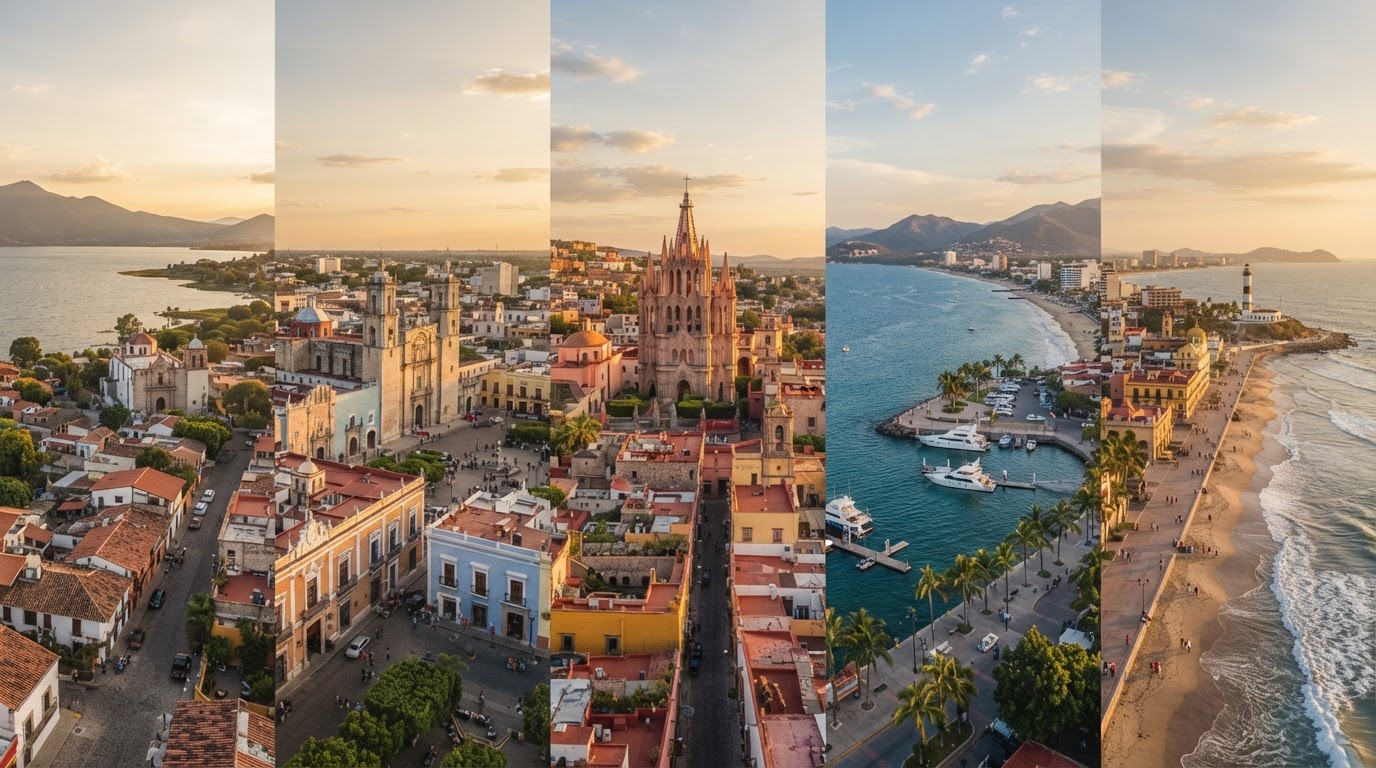
I have spent the better part of two decades writing about people who pack up a life and start another one somewhere warmer. The question I get most from Canadians eyeing Mexico is never “should I do this?” It's “where?” And it's almost always asked as though there is one correct answer, a single town that will appear on enough lists to be declared the winner.
There isn't. A retiree who wants a bridge club and a hospital ten minutes away is not the same person who wants a quiet colonial street where the neighbours are mostly Mexican. Both of those people call this “retiring in Mexico.” They should not move to the same town.
So instead of a ranked list, here are five towns that solve five different problems, with the specific details, rent ranges, flight routes, what the humidity actually does to you in August.
Ajijic, Jalisco
for the retiree who wants a ready made social calendar on day one
If your retirement plan involves joining a Rotary Club within your first month, Ajijic is built for exactly that. This lakeside village on the north shore of Lake Chapala, an hour south of Guadalajara, is home to the largest concentration of North American retirees anywhere in the world. The Lake Chapala Society estimates 15,000 to 20,000 American and Canadian residents live here full time.
Who fits here
Retirees who want infrastructure before adventure. Ajijic has pickleball courts, two Rotary clubs, a birders' club, amateur theatre, and a lending library that functions as the town's unofficial living room. You can get through your first year here without speaking much Spanish, which is either a relief or exactly the problem, depending on why you moved to Mexico in the first place.
The numbers
A well located rental in Ajijic proper runs $1,000 to $1,500 USD a month; walk fifteen minutes inland to Chapala town and the same footprint drops to $800 to $1,200. Jocotepec, at the lake's western end, goes as low as $700 to $1,000 for those willing to trade proximity for savings. A Canadian couple drawing maximum CPP and OAS can, by most local accounting, cover a comfortable life here on government pension income alone if the home is owned outright.
What nobody mentions in the brochure
2026 has been a rockier year on the lake than usual. Rising rents have pushed some longtime residents toward cheaper towns, an underground cable project has torn up streets ahead of Guadalajara's role in the World Cup, and friction between the expat community and local government spilled into public view this spring over traffic and etiquette complaints. None of that erases the appeal. Ajijic's 5,000 foot elevation still delivers what National Geographic once called one of the world's best year round climates, but it's worth visiting in the off season (May or August, not the crowded November peak) before you commit.
Mérida, Yucatán
for the retiree prioritizing safety and culture over beach access
Mérida gets recommended constantly, and for a reason that has nothing to do with hype: it is consistently ranked the safest city in Mexico, with crime rates low enough that people walk the historic centre at 10 p.m. without a second thought. That single fact reorganizes a lot of other decisions for a retiree.
Who fits here
People who want a real city, Mayan and colonial architecture, a metro population near 1.3 million, museums, a Sunday street festival called “Mérida en Domingo” that shuts down downtown for music and food, rather than an expat enclave. It also suits retirees who care more about culture and safety than about waking up next to the ocean; the Gulf coast beaches are a 30-minute drive, not a walk.
The numbers
This is one of the more affordable options on this list. A couple can live comfortably on $1,800 to $2,200 USD a month including rent, and rentals in the $500 to $1,200 range aren't hard to find outside the priciest colonial mansion listings in Centro. The city has an estimated 10,000 to 15,000 international residents, a meaningful share of them Canadian, anchored socially by institutions like the Mérida English Library.
The honest catch
Heat. From April through August, daytime temperatures regularly hit 93 to 97°F with heavy humidity, and there's no lakeside breeze or mountain elevation to soften it the way Ajijic or San Miguel offer. If you run hot, or you're picturing “retire in Mexico” as sweater weather in December, visit in July before you sign anything. The reward for tolerating the climate is excellent, affordable private healthcare and direct flights connecting Mérida's international airport to Canada.
San Miguel de Allende, Guanajuato
for the retiree who wants culture more than a bargain
San Miguel is the most polished small city in Mexico, arguably in the hemisphere. Pink stone church spires, cobblestone streets, and an expat community — 10,000 to 15,000 strong, mostly American and Canadian retirees 55 and older — with enough density to support English language theatre groups, writing workshops, and a public library that functions as the town's cultural anchor.
Who fits here
Retirees for whom art openings, a serious dining scene, and Spanish colonial architecture matter more than stretching every dollar. This is not the budget option on the list, and it isn't trying to be.
The numbers
Expect to pay for the privilege. A comfortable retirement here runs $2,500 to $3,500 USD a month for a couple, and at the upper end — larger homes, more dining out — budgets climb toward $5,000+. Rent for a one-bedroom colonial-style unit starts around $600 to $1,200, but the nicer two-bedrooms in desirable neighbourhoods like San Antonio or Los Frailes push toward $2,000+. It is, by a wide margin, the most expensive town on this list: 40 to 60% cheaper than comparable U.S. or Canadian cities but noticeably pricier than Ajijic or Mérida.
Worth knowing
The altitude (over 6,000 feet) means cooler evenings than the coast and a genuinely temperate climate most of the year, with over 300 days of sunshine. Some longtime expats will tell you the town has gotten expensive enough that it now competes on lifestyle rather than affordability, and they're not wrong. If your retirement math is tight, this may not be your town.
Puerto Vallarta and Bucerías, Jalisco/Nayarit
for the retiree who won't compromise on healthcare or an active social scene
Puerto Vallarta solves a specific problem: it gives you beach living without asking you to give up modern medical care or an international airport with direct routes home. Private hospitals — Hospital CMQ, Hospital San Javier — have English speaking specialists, and dental and cosmetic procedures are priced at a fraction of Canadian costs. Once you hold permanent residency, IMSS enrollment runs roughly $500 to $800 USD a year per person.
Who fits here
Retirees who want an active, walkable lifestyle with real beach access and don't want to choose between the Romántica Zone's LGBTQ+-friendly nightlife, Marina Vallarta's marina and golf scene, or Bucerías' quieter, more residential feel just north of the city — because Banderas Bay offers all three within a short drive of each other.
The numbers
Beachfront-adjacent one-bedrooms run $1,200 to $1,800 USD monthly; a couple can live comfortably on $1,800 to $3,000 including healthcare and dining out. A basic weekly grocery run for two costs $50 to $70, and a doctor's visit runs about $40 — a fifth of what the same appointment costs without insurance back home. To qualify for temporary residency, 2026 rules require roughly $2,100 USD in monthly income or $35,000+ in savings.
The trade off
Puerto Vallarta is a major tourist destination first and a retirement town second, which means both better security infrastructure and more of the opportunistic, tourist-targeted petty crime that comes with high visitor volume. It's also not a budget destination anymore; rising real estate demand has pushed prices up across the bay in the last two years. What you're paying for is convenience: the flights, the hospitals, and a social calendar that doesn't require a car.
Mazatlán, Sinaloa
for the retiree who wants Pacific beach life without Puerto Vallarta prices
Mazatlán is the least discussed town on this list, and it belongs here specifically because of what changed in 2026: WestJet added direct Calgary-to-Mazatlán service to its winter schedule, joining existing routes from Vancouver and other Canadian cities, which shortens the trip home for Prairie retirees who'd otherwise connect through Mexico City or Guadalajara.
Who fits here
Retirees who want genuine beachfront living — the malecón here is one of the longest oceanfront boardwalks in Latin America — without paying Puerto Vallarta or Cabo prices, and who are comfortable in a town that feels more Mexican than expat enclave. Historic Old Mazatlán, with its restored 19th-century plaza and cathedral, draws a different, less insulated crowd than the beachfront Golden Zone hotels.
The numbers
Round-trip flights from Vancouver or Calgary have been found for under $600 CAD in the current booking window. I could not confirm a hard, sourced figure comparing Mazatlán's overall daily cost of living directly against Puerto Vallarta's, so take that comparison as general reputation rather than an audited number; flights and route access are the part of this section that's firmly documented.
What to weigh
Mazatlán's expat and Canadian retiree infrastructure, while long established (Canadians have wintered here for decades), appeared far less often in the research than Ajijic's or San Miguel's, which suggests it's smaller and less centralized, though I don't have a direct source confirming that. For retirees who find Puerto Vallarta's density excessive and Ajijic's landlocked lake life a dealbreaker, Mazatlán is worth a scouting trip even without a headline ranking behind it.
The town isn't the hard part
Every one of these five places can genuinely work for a Canadian retiree, and every one of them has, this year alone, disappointed someone who chose it for the wrong reasons. The town matters less than getting the mechanics right first: your temporary or permanent residency pathway, what happens to your provincial health coverage (OHIP, MSP, AHCIP, RAMQ, or Manitoba Health) once you start spending most of the year outside Canada, and how the CRA treats your departure.
Pick the town that fits your life. Get the paperwork right before you fall in love with it.
Get the paperwork right before you pick your town
Our free 2026 residency eligibility check uses the current financial thresholds to show which Mexican residency you may qualify for and which consulate to apply through.